
While This Mocking Hymn Rings
A Meditation on Christ's Humiliation

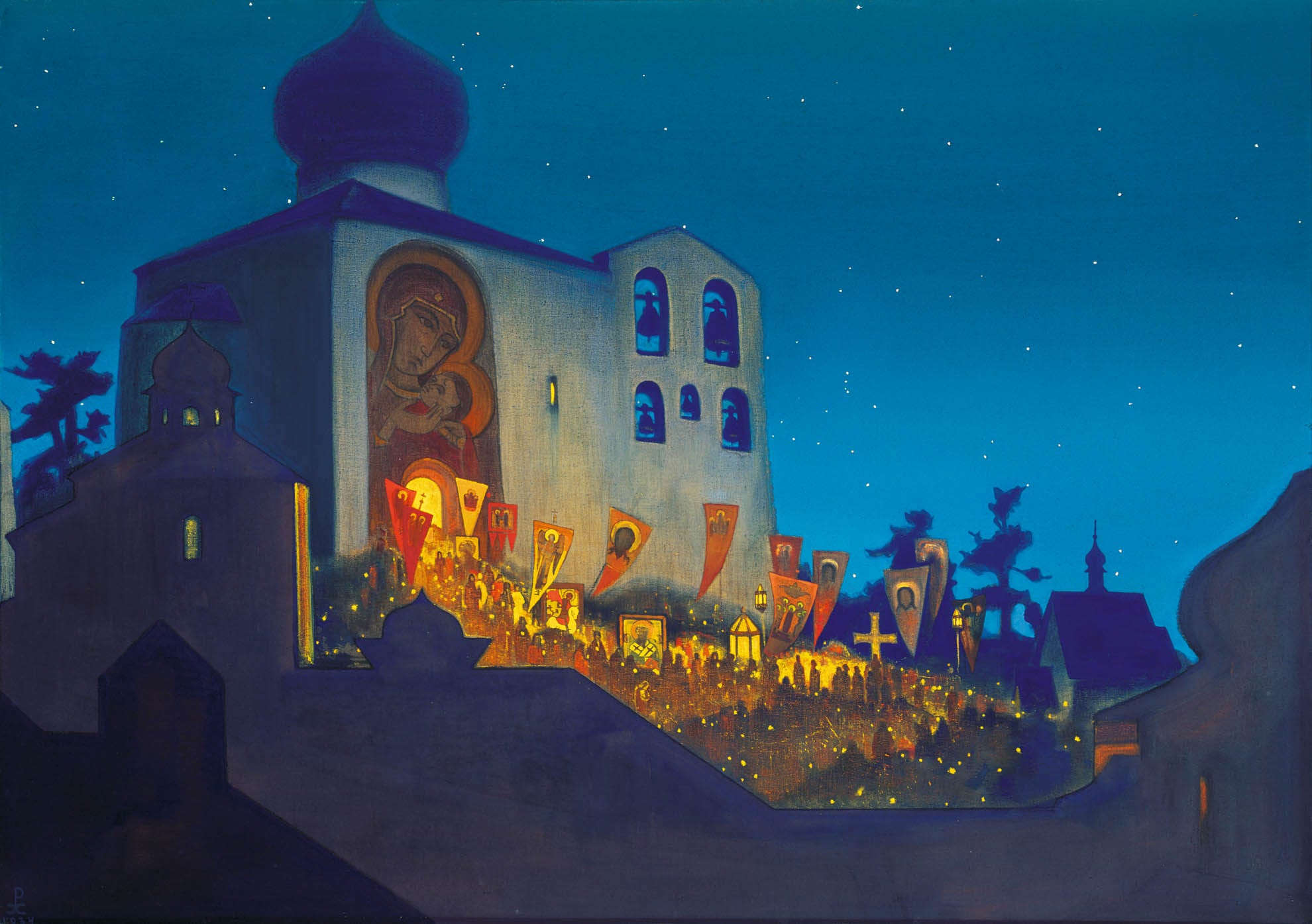
Music and poetry. Both attempt to do the impossible. Both attempt to crystallize that which otherwise cannot be communicated: when all else fails, when all prose is but a pale imitation, music and poetry are there to help us express the inexpressible. When combined in song, they have the power to render us all helpless while tidal waves of emotions course through our veins.1
As you might have guessed, I am writing this because of one such recent experience. I was listening to a part of Rachmaninov’s catalog with which I am not very familiar—his Romances for solo piano and vocalist. One of them in particular nearly bowled me over, enough so that I feel compelled to share it with you. It is an arrangement of a poem by Dmitry Merezhkovsky (1865-1941), one of the founders of the Russian Symbolist movement.2
I have included the original section of the poem below, alongside the given English translation, in case you can’t listen right now. But if you can, you really must listen to this while following the lyrics in the video. (The link below should automatically take you to the correct song; if not, go to the 6th, Christ is Risen, which begins at 12:51.)
«Христос воскрес», — поют во храме;
Но грустно мне... душа молчит:
Мир полон кровью и слезами,
И этот гимн пред алтарями
Так оскорбительно звучит.
Когда б Он был меж нас и видел,
Чего достиг наш славный век,
Как брата брат возненавидел,
Как опозорен человек,
И если б здесь, в блестящем храме
«Христос воскрес» Он услыхал,
Какими б горькими слезами
Перед толпой Он зарыдал!
“The Christ is ris’n” — the choirs are singing,
My soul is sad... my tongue is tied;
Earth still is dark with tears and bloodshed,
The while this mocking hymn is ringing
from every altar far and wide.
Wert thou reborn of Virgin Mother,
To see in these our vaunted days,
How brother still can hate his brother,
How base, how cruel human ways,
And didst Thou hear, from shining temples,
“The Christ is risen,” chanted loud,
What tears of bitterness and sorrow
Thou need’st would weep, Lord, o’er the crowd!
—Dmitry Merezhkovsky, Христос воскрес3
We preach Christ triumphant, yet there remains so much suffering. How can we speak of a God in his exaltation, when Christ spoke to us in his humiliation? We all too easily forget that the Christ who calls us to take up his easy burden and light yoke is the Christ humiliated, the Christ in his kenosis.
But the Christian Church does not wish to recognize the kenotic Christ. Neither does it want to recognize the fact that Christ is a contemporary, a truth which Kierkegaard held particularly dear. Christ was in the world incognito and that was His kenosis. Therefore the acceptance of Him demands faith, that is, freedom. The immediate recognition of Him without any possibility of being led astray would have made the God-Man into an idol. Christ speaks only in humiliation and not in exaltation, whereas man wants to begin with exaltation and not with humiliation. […] Christ regarded suffering as triumph, and the necessary thing is to imitate Him, not to be enraptured by Him and to worship Him.
—Nikolai Berdyaev, The Divine and The Human
Whatever we do to the least of these, we do unto Christ. Why do I—in my authority-less state I have no ability to speak for anyone else—why do I so often forget those simple words? How can I proclaim that Christ is risen when so much of His body suffers under the weight of sin? If I claim to love Christ but do not love my brother, I am a liar. If I claim that Christ is risen but do not raise His body, I am a liar. If I say to someone “Peace be with you” without giving them that which is necessary for peace, James asks us “what good is that?”
If Christ’s body is not raised, then Christ is not raised. Yet one of the mysteries of the Church is that the body of Christ is the Church. Thus the resurrection is not complete, no, not until the whole body of Christ is raised; Christ in his body as an individual is only the firstfruits of resurrection life. Until the whole body of Christ is raised, Christ speaks to us only from his humiliated and kenotic state, not his exalted and glorified state. As Berdyaev says, the most important thing therefore is not to worship him but to imitate him—to have an ear for the needy and eyes for the sick, to suffer for the sake of others.
Earth still is dark with tears and bloodshed,
The while this mocking hymn is ringing
from every altar far and wide.
Earth remains, then as now, dark with tears and bloodshed. There is work yet to be done. Let us go forth, brethren, striving so that our hymn may become a little less mocking, a little closer to truth.
It seems to me that the subjectivity of the experience is central to this power. Music and poetry can speak to each of us at the core of our being because these arts force us to the hard work of interpretation. If you haven’t already read it, I highly recommend Naucratic Expeditions’s most recent article, linked at the bottom of this footnote. There are many wonderful responses from scholars of various fields on what constitutes “revelation,” but what’s stuck out to me as it relates to this is the following from Matthew Milliner:
“The error would be that conceding an (inevitable) degree of subjectivity somehow eliminates the genuine inbreaking that comes with the revelation of God. […] [We must remember] that for Christians, revelation includes a visual element. As Theodore the Studite put it, ‘If a merely mental contemplation were sufficient, it would have been sufficient for Him to come to us in a merely mental way’ (On the Holy Icons 3, trans. Catherine Roth, 22).”
Since Christ came to us not merely mentally but visually, aurally, physically, etc., it seems to me that revelation must include all five senses. In particular, revelation can occur also through music.

If you want to learn more about the Russian Symbolist and Russian Cosmist movements, I highly recommend Jeremiah Carey’s work on several prominent thinkers of the era. This article of his, on Solovyov and the Meaning of History, is one I particularly enjoyed:

He has also done some work on a little-studied figure from the same time by the name of Valentin Sventsitsky, which is well worth your time. One such article is found here:
The Russian text is taken from here. While there is an English translation at the same link, the English translation in the main text follows that given by Rosa Newmarch in the Youtube video. My understanding after conversing with a friend who knows Russian is that the translation in the link is much more accurate at a word-for-word level, but the Newmarch translation is closer in capturing the feeling and the overall structure.