
St. Paul said to do...what?
An Exploration of Christian Existentialism: Part II

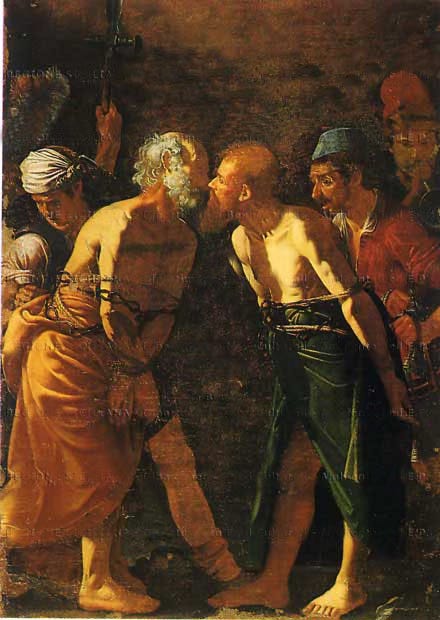
Romans 16:16: Greet one another with a holy kiss. All the churches of Christ greet you.
1 Corinthians 16:20: All the brothers and sisters send greetings. Greet one another with a holy kiss.
2 Corinthians 13:11-12: Finally, brothers and sisters, farewell. Be restored; listen to my appeal; agree with one another; live in peace; and the God of love and peace will be with you. 12 Greet one another with a holy kiss. All the saints greet you.
1 Thessalonians 5:26: Greet all the brothers and sisters with a holy kiss.
1 Peter 5:14: Greet one another with a kiss of love. Peace to all of you who are in Christ.1
Isn’t it a bit odd that a command which is repeated in the New Testament in five different letters is wholly forgotten (or, worse, actively ignored) in the majority of American churches today? If you were at any point a regular churchgoer in America, is there a time you can recall where this command was listened to in any regard? I certainly can’t. We are more likely to ask “What on earth was St. Paul thinking?” than to listen on this one. I think this is a bigger issue than most of us realize. And I think one of our Christian Existentialists can, in a roundabout way, help us see what the issue is more clearly.
Last time, we focused on a concept that Tillich calls the existential attitude. As we saw, all four of our thinkers express some form of this idea—there are certain realms of life which require us to engage them with the whole of our person:
The existential attitude is one of involvement in contrast to a merely theoretical or detached attitude. “Existential” in this sense can be defined as participating in a situation, especially a cognitive situation, with the whole of one’s existence. This includes temporal, spatial, historical, psychological, sociological, biological conditions. (The Courage to Be, p. 115, bold my own)
What we will focus on today is one of the factors in the bolded list; one which, strangely in my eyes, only one of our authors devoted any time to. It is that of our biology, our embodiment. Perhaps the other three authors discuss this theme elsewhere. In my readings, only Marcel devoted substantial time and energy to thinking about the importance of our bodies for entering the existential attitude. (If you haven’t already, I recommend at least glancing at part one, so that you can get a sense of the sort of participation Tillich and the others are speaking of.)
The Existentialist Attitude

When you think of existentialism and her thinkers, you likely think of an atheist existentialist: Nietzsche, Sartre, Beauvoir, maybe Heidegger or Camus. This is not without good reason; they were the chief popularizers of existentialism as we conceive of it today. Because of their predominance not only as famous existentialists but as famous philosopher…
It should be noted, before we dive in, that Marcel’s text Creative Fidelity is really a collection of essays whose aim is to sketch a panorama of his philosophy. My focus here will be on the first “chapter” of Creative Fidelity, entitled Incarnate being as the central datum of metaphysical reflection. While this idea does come up with some frequency throughout Creative Fidelity, it is not a main focus again in the book. If you, as I do, want to further explore Marcel’s thoughts on embodiment, we shall have to look elsewhere.
Where Shall We Begin?
The question of where to begin philosophical inquiry, a point which we hope will be a certain and sure point from which to depart, is an important one. The goal of philosophy is to understand our lives, our experiences, and the world: from the myriad possible places, whence shall we start our project? Marcel says that this inquiry “must be based on a certitude which is not rational or logical but existential; if existence is not at the beginning it is nowhere...” (p. 15, bold mine).2 Solipsism, he says, is not self-contradictory, but empty and meaningless. Solipsism is a denial of “existence” to all things except myself—but it is impossible to deny existence to “all things” without failing to properly define “existence.” So, something exists. Is there some privileged existent which we cannot deny without absurdity and contradiction? Yes: it is that I exist. But not merely the “I” as identified with my subjective reality or selfhood:
If the self that I am is construed as a subject, a subjective reality, if the “I” in “I exist” is identified with this subjective reality, then the assertion cannot stand up under scrutiny. What justifies the assertion, the criteria of validity, cannot be determined. The assertion “I exist” is valid only if it signifies, in an admittedly loose and inadequate way, an original datum which is not “I think” nor even “I am alive,” but rather “I experience,” and this expression must be accepted in its maximal range of indefiniteness. (p. 16)
In other words, I can know with certainty that I exist, yet not because I am thinking nor because I am living, but because I am experiencing. Berdyaev would likely assent to this, saying “I suffer, therefore, I exist. This is truer and more profound than the cogito of Descartes.”3 In this Cartesian mode, the fact of my experiencing gives me certainty that “I” exist. But this is not anywhere close to capturing the full extent of “existence”:
Of course, by a conscious act of abstraction I can apprehend myself as a being of pure feeling. On this basis I can, in the cartesian mode, infer that I am. But when I assert: I exist, I certainly mean something more than this; I vaguely imply that I am not only for myself but that I manifest myself, or rather am manifested; the prefix ex in exist, has primary significance because it conveys the meaning of a movement towards the external world, a centrifugal tendency. I exist: that means I have something by which I can be known or identified, either by another person or by myself insofar as I assume for myself a borrowed otherness; none of these characteristics are separable from the fact that “there is my body.” (p. 17, bold my own)
For Marcel, our embodied existence is the central fact of our existence, and indeed is constitutive of our existence. To exist is not only to exist for myself: the prefix ex- denotes that I exist in an outward facing manner. This can be said of me when we consider my body. The importance of the body, then, cannot be overstated—it is the center node from which everything else in one’s life shines outward. My body “is the datum relative to which there are other existents, and, it may be added, the basis of the division between existence and non-existence.” (p. 17) The example he gives of how my body determines existence and non-existence is that of Caesar: to say that “Caesar existed” is not simply to say that Caesar would have been perceived by me, were I present. This claim goes further; it is a claim that there is “an objectively determinable temporal continuity” (p. 18) between Caesar’s existence and my own.4
“I” and “My Body”
Having established experience—that is to say, my body—as the foundational point from which to begin philosophy,5 Marcel now turns to a rather thorny question. What are we to do with the phrase “my body”? What is the relationship between “I” and “my body”? Every way we turn to resolve this only runs us into trouble. We might be first tempted to say that my body is my instrument. Instruments are means of extending or strengthening the natural capabilities of people: eyeglasses extend our vision, knives sharpen our ability to slice, a ladder my ability to reach things. Each of these tools take a capacity I already have and furthers it in some way. Can the same be said of my body?
On first glance, it appears possible to say yes, my body is my instrument. This is especially so if you are used to thinking of the human body from an external, scientific perspective—doctors, in virtue of their profession, must daily consider the natural capacities and powers of the human body. But this view is a view from outside—and I am not outside my own body. If we suppose my body is an instrument, the killing question to this view is “an instrument of what?” Any answer is in danger of an infinite regress: if my body is an instrument of my soul, then the body extends the capacities my soul naturally has. But then that soul may be said, by the same logic, to be an instrument of something else, and we fall into the abyss. So my body is not my instrument. This argument, says Marcel, holds true for any objective relationship whatsoever that we might imagine betwixt “my body” and “I”. There is no room for a gap between myself and my body.
Does this then mean that I am reducible to my body, that materialism is true? Marcel thinks not.
The alleged identity is absurd; it is possible to affirm it only if the I is first implicitly denied, thereby becoming the materialist assertion: my body is myself, only my body exists. But this assertion is absurd. For it is a property of my body that it does not and cannot exist alone. [...] Furthermore, in a purely objective world, what becomes of the principle of intimacy (my body) around which the existential orbit is created? (p. 19)
Now, I admit to being a tad confused on his argument here. It is not so clear to me why he jumps from “my body is myself” to “only my body exists” to “my body does not exist alone, therefore this is false”. Where I do agree with him here, however, is that if we naively reduce “I” to “my body”, we lose the ability to meaningfully talk about persons existing at all. There is clearly something to this principle of intimacy—my body, not anyone else’s—that we lose by making this materialist assumption. This leaves us with quandary: we can neither identify “myself” with “my body”, nor can we speak of “myself” having some concrete relationship and therefore distance between “my body”. This leads to Marcel’s notion of incarnate being:
To be incarnated is to appear to oneself as body, as this particular body, without being identified with it nor distinguished from it—identification and distinction being correlative operations which are significant only in the realm of objects. What clearly emerges from the foregoing reflections is the fact that there is no distinct haven to which I can repair either outside of or within my body. Disincarnation is not practically possible and is precluded by my very structure. (p. 20, bold mine)
We can neither be identified with nor distinguished from our bodies, because our bodies in truth cannot be existentially considered as objects but must be considered as subjects. This raises a strange paradox. I can only have scientific knowledge of my body by considering it as not my body. It is by viewing my body as one object in an infinite world of objects that I can gain scientific knowledge about it. We can only be knowing subjects in this way if we relate to our bodies as if we were not our bodies. Marcel goes even further:
If I abstract from the index characterizing my body—insofar as it is mine—if I construe it as one body among an unlimited number of other such bodies, I will be forced to treat it as an object, [...] It then becomes an object of scientific knowledge; it becomes problematic, so to speak, but only on condition that I consider it as not—mine; and this detachment which is essentially illusory, is the very basis of all cognition. As knowing subject, I re-establish or claim to re-establish that dualism between my body and me, that interval which, we have learned, is inconceivable from an existential point of view. [...] This paradox is fundamental for the object, for I can really think about the object only if I acknowledge that I do not count for it, that it does not take me into account. (p. 20)
In a roundabout way, Marcel seems to be describing the difference between science and phenomenology. Science requires that we consider the world as objects. Science can only be done in an objectivizing mode; if I want to understand my own experience as an individual self, I therefore cannot do science. This is where phenomenology—the study of the structures of consciousness—steps in. Phenomenology comes with the added difficulty of recognizing that, just by observing that you are having experience, you change the character of that experience!
Consider a rather banal example. You are sitting in class, attempting to give your attention to what is a rather boring and ill-structured lecture. Your leg, without conscious intention, is bouncing up and down. Your experience of bouncing your leg up and down while focusing your full attention on the lecturer is very different from your experience once you become aware of your leg! Studying this difference is the realm of phenomenology; it is difficult precisely because the very act of turning your attention towards a particular experience has the capacity to destroy that experience.6
The Mystery of Incarnate Being
“I can think about the object only if I acknowledge that I do not count for it, that it does not take me into account.” When we take a fully objective stance towards the world, we cut off our connection to the world. The world, perceived as object, ceases to be something involved with me and disregards me entirely—for objects do not take me into account. It is here that Marcel begins to unpack his own version of the existential attitude:
What this amounts to is that the act of trying to break the nexus uniting me to the universe, because of a fear of anthropocentrism, nexus of my presence to the world, my body being this nexus manifested, is a purely abstract act. [...] I am not postulating any kind of dependence of the universe on me; this would be a relapse to an extreme subjectivism. What I am asserting, first of all, is the primacy of the existential over the ideal, with the added proviso that the existential must inevitably be related to incarnate being, i.e. to the fact of being in the world. (p. 21, bold my own)
Our incarnate being, he says, is our “fundamental situation.” Our embodiment is not a contingent fact—there is no sense in attempting to say that I am embodied, but I could have been otherwise. This embodiment is inevitably related to the existential, not the ideal. Any philosophizing we do cannot begin with abstract concepts, but must begin with the concrete, real fact that is my embodied existence, my incarnate being.
As we have seen, this embodiment is a paradoxical experience. Although I cannot be distinguished from my body, I am capable of taking a stance that considers my body as an object. I can look upon my body with a mirror; I can divorce myself from it; ultimately I can attempt to disavow it, as one might disavow a friend or relative. Yet our reflections have shown that it is neither possible to identify myself with this body, nor to separate or distinguish myself from it. This mystery forms the basis for Marcel’s philosophy: the existential, the concrete, must always hold primacy over the ideal and the abstract. That is, we must begin with nothing other than our bodies.
The premises of what I venture to call concrete or existential philosophy have thus been established in a somewhat indirect and unexpected way. This philosophy is based on a datum which is not transparent to reflection, and which, when reflected, implies an awareness not of contradiction but of a fundamental mystery, becoming an antimony as soon as discursive thought tries to reduce or problematize it. (p. 23, bold my own)
An important distinction in Marcel’s philosophy is that between “problems” and “mysteries”. Steve Knepper has a wonderful article in Commonweal that dives into this difference, which he summarizes as follows:
A problem is something external to us. It can be solved with the proper, generalizable technique. A mystery, on the other hand, is something from which we cannot extricate ourselves. Marcel called a mystery a “problem which encroaches upon its own data.” It has roots in the depths of our being, but it also reaches beyond us. There is no general technique for addressing a mystery. It can only be lived out with a wisdom responsive to the particulars of the situation and the people involved. Birth, love, and death are central mysteries for Marcel. The death of a child involves a parent in all three.
Problems are things which can be solved, reduced, done away with, set aside; mysteries must be lived. Our embodiment is one such mystery.7 We cannot escape it, we cannot reduce it to a mere tool nor reduce our subjectivity to it, it is simply to be experienced.
What, Then, With the Kiss of Love?
As we have seen, the body is fundamental to our very existence. We cannot be separated from our bodies, they constitute our very being, they are that something “by which I can be known or identified, either by another person or by myself.” What lessons can we take away from this?
For starters, I think these reflections help us to understand why there are five different commands in the New Testament for Christians to greet one another “with the kiss of love.” Consider a moment where you, in your own life, have felt particularly loved by a friend. It is eminently natural for us to describe such a moment as “touching”. Why? Because each of us to some degree recognize that I am not distinguishable from my body. A touching act is one which sneaks past our usual walls, leaps across roaring rivers, crosses the inner defenses of our being, and tells us that we are loved. Physically touching another person is an important and, all-too-often, forgotten way of—touching people! We are commanded to do this because our physicality is not a mere accident, it is a gift and it is fundamental to our existence as selves. Our bodies are not curses. We would do well to recognize that this, too, is “very good”.
There is a connection we miss when we read these commandments to kiss one another in translation: the word for kiss, φίλημα, shares the same root as that for friendship, φίλος. To kiss and to be a friend are so conceptually connected in the Ancient Greek world that they share the same root word. This is a fully embodied understanding of friendship. Do we view friendships as relationships important enough to kiss the other person? It seems we ought to—because in the language of the New Testament, these two ideas are tied together at their centers. Friendship mandated an awareness of the other person’s embodiment. How impoverished are we, who cannot see the value and the beauty of another person’s body without sexual desire being involved!
Indeed, if Marcel’s analysis is correct and incarnate being is the central datum of the human life, to love another person simply is to love their body. This is a scandalous thought for us, at least here in Texas where I grew up. I love my friends, sure, but their bodies?? “No, no y’see, loving another person’s body isn’t for friendship, that’s only for marriage.“ We, with Marcel, must recognize that this is not only wrong, but incoherent. Those whom I love may not be reducible to their bodies, but neither can they be separated from them. To imagine loving a person without loving their body is to imagine nothing at all.
Of course, this need not mean we literally kiss one another as a greeting—although that could be very cool!8—but it does mean we should consider how we can show love to one another in more physically incarnate ways. I think here of the earliest form of the Eucharist, which was much closer to a feast-meal with much food and drink and joyous laughter than what we have today. This is a physical care; humans cannot survive without food and drink. No less than Ecclesiastes, my favorite book of the Bible, says that this is the sum of meaning of the human life:
Ecclesiastes 8:15: And I commend joy, for man has nothing better under the sun but to eat and drink and be joyful, for this will go with him in his toil through the days of his life that God has given him under the sun. (ESV)
But there are also simpler things we can do to engage one another’s physicality without kissing one another.9 Hugs are excellent, for starters. And, if you’re comfortable holding hands during prayer, try holding hands with people you aren’t married to in other contexts! It’s really rather odd, if you stop and reflect a moment, that we’ve sexualized or romanticized holding hands with other people. Plenty of current-day cultures do not see it this way—everywhere from the Middle East, to Korea, to Sicily sees it fitting for friends to hold hands. And, if you’re not one for the touchy-feely forms, try sports! I think these would be excellent applications of “greet one another with the kiss of love” to our own context.
Now, I have written about the command to greet one another with a kiss before; if you want some expanded thoughts on the kiss of love, especially in connection with Kierkegaard, you can read that article here. Where I will end instead of repeating those thoughts is with the following. What does it say, what should it say to us, about the relationship between Christianity and the physical world that our two most important sacraments—baptism and the Eucharist—are so profoundly physical? For the one, we are eating and drinking, the acts which sustain and nourish the body; for the other, we partake in being born and reborn, life and new life. Should it not speak to us that, in the two most important rituals of the Christian liturgical life, God saw fit to reach down and nourish not only our souls, but our bodies too? If our bodies are good enough for God to bring into His life, should they not also be good enough for us? Shall we not rejoice in this most central fact of our being, that we are bodies?
All translations from NRSVue.
All citations in this article, if stated with only a page number and no title, refer to Creative Fidelity.
The Divine and The Human, p. 66.
I am not quite sure how Marcel would view the existence or non-existence of, say, the natural numbers as platonic forms. I am intuitively a platonist about mathematics, and my own intuition is to say that the account of existence that he gives here is one which holds for things which physically exist, but does not extend to purely mental existents—but perhaps I’m wrong here. Maybe the platonic numbers are imprinting themselves upon my brain ;) who knows? Perhaps Matthew R. Guertin has some thoughts on this one?
Although I have not yet read Merleau-Ponty’s The Phenomenology of Perception, the impression I get is that he would absolutely agree with Marcel on this point. This is not too surprising, I suppose, given that Marcel and MMP had regular interaction with each other during their years in Paris.
Another example may be helpful, that of lucid dreaming. I, at least, have never had a fully lucid dream, but I have gotten far enough that I briefly realized “woah, I’m dreaming!” before awaking. I in my current capacity am only able to have dreams while being unaware that I am dreaming. The very act of turning my attention to the dream destroys the dream. This is the difficulty with doing phenomenology.
This is one place where I think, if not all, then at least many forms of transhumanism completely misunderstand what it is to be human. If you delete the human body from existence and “upload your consciousness to a computer”, you are left with nothing human at all. Even ignoring the host of philosophical quandaries that are raised when we consider the possibility of uploading consciousness to electronics—how would we verify that that “consciousness” is “the real person”?—we are still left with this fundamental misunderstanding—we are not separate from our bodies.
At least, it would be very cool if we all managed to collectively undo our cultural training not to do this. I am by no means at a point where I would be fully comfortable cognitively with the act of kissing every member of my parish on the cheek. But that does not mean I do not recognize the value that would be in such an act.
Although I think all of this is applicable for anyone reading this, many of these suggestions are especially things that my fellow men need to hear. America is far too prudish about public displays of affection for one’s friends, and especially for men.
My *hunch*, at this stage, is that mathematical objects aren't "out there" but are rather re-presebtations to ourselves of our own cognitional operations over understood externalities/extensionalities. In that, they do have roots in something real and transcendent—i.e., on/in spirit and that on which spirit depends (which I think we can tell stories about but I'm not so sure these days we can *know* as a what-it-is. But yeah, tgere are differrnt forms of Platonism and differrnt ways of meaning "objects."